
ELIRABREGU
Lead with Purpose | Tell Your Story | Create Meaningful Change
Search Results
Search this site
589 results found with an empty search
- Waiting for Love Not Chasing it!
What if we stopped searching for love and waited for it to arrive? Eventually, all the searching we do for love tires us out. I know it did for me. Reaching outside of myself to look for it is a struggle that leaves me slightly crazed, insecure, and hollow. When we want the outer world to appease our inner fears, it rarely (if ever) does. Instead, when we do this, we are left feeling broken (the opposite of what we desired). You know that really sweet idea we have about love—the one we are told about in songs, movies, and society in general? Well, it’s not true. When we pursue the belief that another person or experience will offer us the opportunity to (finally) feel complete, we are headed for trouble . This is what we do so often in life—we expect something else to make us feel whole. To believe that our worth comes from the outside make us feel more need for love. This is honest information—no one will ever be enough to fulfil us if we cannot fulfil ourselves. The ironic thing is that when we chase after something, it usually just makes that thing run away faster. It is not much we actually can control. Why would we try it with something wild as love? Everything in life is constantly changing and the change is out of our control. In this teaching lies the foundation for an acceptance of something really big—the principle of impermanence. If we can accept impermanence, then we are not surprised when our external world is what it is — undependable. Rather, we realize this is so, and we find something underneath that is more real and solid. Buddhists believe that the one thing we can learn to depend on is our own self. We learn that instead of chasing experiences or people to fulfil our needs, we attend to them first. This is done by becoming tender at this moment. Instead of thinking that another thing might complete us, we choose to do the compassionate work of finding our own completeness—presently. We turn our gaze toward ourselves, and we look inward. The way out of suffering is within ourselves. Our freedom is found by returning to our own hearts, not in turning to another’s. Isn’t that what we all want—to feel good about who we are? The Key to Allowing Love to Arrive is Self-Love. Chasing love then becomes so “last year,” because we realize we already have it. This reverses our sense of being broken—we stop believing that we are lacking anything. Imagine if we’d been doing this our entire lives? How full would we feel? Instead of being conditioned to dislike who we are, we’d see ourselves without judgment. Accepting ourselves is the way we can allow love to arrive. It won’t happen immediately. Loving ourselves takes time to learn how to do. For me, self-love came after I’d exhausted all other resources of trying to get it somewhere else. And trust me, I tried. But here’s the thing, when we begin the tender journey of loving ourselves, then others become more drawn to us. When we already feel complete, it takes the pressure off of everyone. Then, others naturally want to be near us. The really funny thing is that we won’t care so much. We no longer need them to feel validated. So please, take the risk—give up of this endless search for love. The way out is within. Let’s hold and adore ourselves. Let’s observe ourselves without judgement. We are whole. We don’t need anything to be different. Things are fine just as they are. Now, we can truly begin to know love—for the love from our very own heart has finally arrived. Author: Sarah Norrad Instead of Searching for Love, Allow it to Arrive — Buddhist Style. #elephantjournal
- Before Television’s biggest night goes live...
Television’s biggest night goes live from the Microsoft Theater in Los Angeles on Monday Sept 17th. The TV stars will be out in full force celebrating the year’s best performances on the small screen. But before the awards show kicks off, here is everything you need to know about this year's ceremony. Catch ET's live red carpet coverage of the Emmys on ETonline.com (check your local listings) for all the post-Emmy festivities! Colin Jost and Michael Che from the Saturday Night Live's show will co-hosted the EMMY Awards show this year. Now let’s move to the presenter which this year will looks like full of celebrities including Jimmy Kimmel, Elisabeth Moss, Ben Stiller, Sarah Paulson, Kit Harington, Calire Foy, Matt Smith, Patricia Arquette, Alec Baldwin, Sandra Oh, Erica Bana, Tina Fey, Taraji P. Henson, Bob Odenkirk, Connie Britton, RuPaul, Mille Bobby Brown, Andy Samberg, Issa Rae, Rachel Brosnahan, Kate McKinnon, Michael Douglas, Angela Bassett, Tracy Morgan, Samantha Bee, Hannah Gadsby, Constance Wu, Benicio Del Toro, Ilana Glazer, Abbi Jacobson and the cast of Queer Eye. “Game of Thrones” and “Westworld” are expected to win big this year, receiving 22 and 21 nominations. Saturday Night Live also is up for 21 awards, followed by The Handmaid's Tale with 20, Atlanta with 16 and The Marvelous Mrs. Maisel with 14. Additionally, we'll have our eyes on Sandra Oh, who could potentially make Emmy history for the second time this year if she nabs the award for Best Lead Actress in a Drama Series for her role as MI-5 officer Eve Polastri on BBC America's critically acclaimed series, Killing Eve. When the nominations were announced in July, she became the first woman of Asian descent to be recognized in a lead actress category, in either comedy or drama, at the Emmys. There are also plenty of Emmy first-timers this year, including Nikolaj Coster-Waldau for Game of Thrones, Ricky Martin for The Assassination of Gianni Versace: American Crime Story and Issa Rae for Insecure. The Monday's awards battle will surely be on between HBO and Netflix! HBO is currently ahead of Netflix by one Emmy win so far. It's interesting to note, however, that Netflix has received more Emmy nominations than HBO this year, ending a 17-year streak for the network. In the meantime, hear more on the 2018 Emmys in the video below, and click through the slideshow to see ET's picks for the Best Dressed stars at last year's awards ceremony. Read more on ETONLINE
- 'Too little, too late' the lawmakers say
To strengthen election security the U.S. President Donald Trump signed an executive order today by slapping sanctions on foreign countries or people who try to interfere in the U.S. political process. “Too little, too late.” Criticized the lawmakers, both Republican and Democratic, explaining, “The executive order, which would give the president decision-making power on imposing sanctions, was insufficient.” “Today’s announcement by the administration recognizes the threat, but does not go far enough to address it,” said Republican Senator Marco Rubio and Democratic Senator Chris Van Hollen in a joint statement, advocating legislation. Only eight weeks before congressional elections on Nov. 6, Trump signed the order behind closed doors with no reporters present. “As I have made clear, the United States will not tolerate any form of foreign meddling in our elections,” Trump said in a statement. Sanctions could include freezing assets, restricting foreign exchange transactions, limiting access to U.S. financial institutions, and prohibiting U.S. citizens from investing in companies involved, national security adviser John Bolton told reporters. “Sanctions could be imposed during or after an election, based on the evidence gathered.” Bolton added. U.S. intelligence agencies concluded that entities backed by the Kremlin sought to boost Republican Trump’s chances of winning the White House in the 2016 election against his Democratic opponent, Hillary Clinton. But Trump in July publicly accepted Russian President Vladimir Putin’s denials at a joint press conference after they met for a summit in Helsinki. Special Counsel Robert Mueller and congressional panels are investigating Russian interference, which Moscow denies. Mueller is also looking into possible collusion between the Trump campaign and Russian officials. Trump dismisses the investigations as a political witch hunt. Reported by Jeff Mason, Steve Holland Click here to read the AUTOMATIC SANCTIONS #ReutersNews
- 'National Security Vulnerability’ remains Unaddressed by Social Media
Social Media executives of Facebook Inc (FB.O) and Twitter Inc (TWTR.N) faced U.S. lawmakers on Wednesday over the ongoing threat of foreign efforts to influence U.S. politics through their platforms. Google was also asked to testify, but the committee declined an offer to hear from Chief Legal Officer Kent Walker rather than Alphabet Chief Executive Larry Page. "Google might have skipped the hearing because it was “arrogant.” Republican Senator Marco Rubio said. "Google takes foreign interference in politics very seriously." Walker wrote on his 'testimony' ahead of the hearing. “The companies and Alphabet Inc’s (GOOGL.O) Google have not done enough to slow the spread of disinformation, and threatened “action.” Started the hearing senator Mark Warner, the committee’s Democratic vice chairman. Facebook Chief Operating Officer Sheryl Sandberg acknowledged that the company was too slow to respond to Russian efforts to interfere in the 2016 U.S. election, but insisted it is doing better. “We’ve removed hundreds of pages and accounts involved in coordinated inauthentic behavior - meaning they misled others about who they were and what they were doing,” Sandberg told the Senate Intelligence Committee. Twitter’s monitoring has tightened, including notifying law enforcement last month of accounts that appeared to be located in Iran.” testified Jack Dorsey, Twitter Chief Executive. Facebook, Twitter and other technology firms have been on the defensive for many months over political influence activity on their sites as well as concerns over user privacy. Their stocks fell as the hearing progressed, with Twitter down 4.5 percent and Facebook around 1.2 percent lower. Shares of Alphabet sank 1.4 percent. Investors are concerned “about how government and policies could pose as a threat to these growth stocks,” said Ryan Nauman, market strategist at Informa Financial Intelligence in Zephyr Cove, Nevada. “Unfortunately, what I described as ‘national security vulnerability,’ and ‘unacceptable risk,’ back in November remains unaddressed.” Said Senator Richard Burr, the committee’s Republican chairman. “Clearly, this problem is not going away. I’m not even sure it’s trending in the right direction,” he added. Warner said social media companies were doing better at combating disinformation, but their efforts were insufficient. “I’m skeptical that, ultimately, you’ll be able to truly address this challenge on your own. Congress is going to have to take action here,” Warner said. “Why Twitter does not tell users when they have been attacked.” Asked Republican Senator Susan Collins explaining that, based on a university report, she had been targeted some 270 times by Russian-linked trolls on Twitter. Twitter's Dorsey answered it was “unacceptable” that she was not told. Before the hearing, President Donald Trump, accused the companies themselves of interfering in the upcoming U.S. mid-term elections, telling the Daily Caller that social media firms are “super liberal.” Trump told the conservative outlet in an interview conducted on Tuesday that “I think they already have” interfered in the Nov. 6 election. Executives of social media companies have testified in Congress several times, including 10 hours of questioning of Facebook Chief Executive Mark Zuckerberg over two days in April. And they all have repeatedly denied political bias. Senate Intelligence has been looking into Russian efforts to influence U.S. public opinion throughout Trump’s presidency, after U.S. intelligence agencies concluded that Kremlin-backed entities sought to boost his chances of winning the White House in 2016. Moscow denies involvement, and Trump - backed by some of his fellow Republicans in Congress - has repeatedly dismissed investigations of the issue as a partisan witch hunt or hoax. Reporting by Munsif Vengattil #ReutersNews
- What would have been M.J. 60th birthday?
Michael Jackson’s children, family members and friends came together to launch an auction, accept a posthumous award and remember the singer on what would have been his 60th birthday. The “King of Pop,” children, Paris and Prince Jackson, brothers Tito and Jackie and R&B singer Usher joined some 1,500 guests in Las Vegas on Wednesday for a performance of the Cirque du Soleil show “One,” based on music by the “Thriller” singer. Jackson died in Los Angeles in June 2009 after an accidental overdose of the powerful anesthetic propofol that he was using as a sleep aid. His personal doctor, Conrad Murray, served two years in prison for causing his death through negligence. Prince Jackson along his sister Paris who is the ambassador of Elizabeth Taylor AIDS Foundation accepted the Legacy Award for their father. “It is a privilege and honor to be here about something that my dad was so passionate about,” Prince Jackson said. The siblings also launched an auction for a newly created pair of ruby and diamond-studded sneakers that are expected to fetch more than $50,000 at a November sale. The money will go to Taylor’s AIDS foundation. Reporting by Jill Serjeant;
- U.S. Vice President Joe Biden leads Memorial Service of John McCain
The commemoration of the war hero and two-time Republican presidential candidate John McCain will be led by the former U.S. Vice President Joe Biden on Thursday at a Phoenix church. The memorial service at the North Phoenix Baptist Church marks the second of five days of commemorative tributes to McCain, who died on Saturday after a nearly yearlong battle with brain cancer. He was 81. McCain’s casket was borne to the church from the Arizona statehouse in a motorcade under police motorcycle escort along a six-mile (10-km) route lined with spectators who turned out to watch the passing hearse. On Wednesday, several thousand admirers stood in line for hours in the blazing Arizona sun and triple-digit heat to pay final respects to McCain, eventually filing past his flag-draped coffin as it lay in state in the Arizona Capital rotunda. The onetime U.S. Navy fighter pilot endured 5-1/2 years as a prisoner of war in Vietnam after his aircraft was shot down over Hanoi. He went on to a celebrated career on Capitol Hill, earning a reputation as a political maverick who prided himself on working across party lines on issues such as immigration, climate change and campaign finance reform. As chairman of the Senate Armed Services Committee, he also became a leading voice on national defense. McCain stood out during the last two years of his life as a leading Republican critic of U.S. President Donald Trump, a fellow Republican whom McCain’s family has asked not to attend his funeral on Saturday at Washington’s National Cathedral. Thursday’s plans called for a hearse to carry McCain’s coffin in the morning from the Arizona statehouse to the north Phoenix church, leading a motorcade that members of the public were invited to join. In addition to loved ones, as well as civic, business and tribal leaders invited to the service from across Arizona, organizers have made about 1,000 seats available at the church for members of the public. The main speech in tribute to McCain was to be delivered by Biden, a friend and former six-term senator from Delaware who was elected vice president as the running mate of McCain’s rival for the White House, Barack Obama, who defeated McCain in the 2008 presidential race. Larry Fitzgerald, a McCain friend and wide receiver for the National Football League’s Arizona Cardinals, will also speak at Thursday’s service. #ReutersNews
- Chaos grip Maduro’s government as Venezuela melts down.
Reuters Special Report: Senior Venezuela's government officials give contradictory statements on petroleum reserves issue . Located in an isolated savanna in the center of the country, Atapirire is the only town in an area the government says is brimming with 5 billion barrels of petroleum. Venezuela has pledged those reserves as backing for a digital currency dubbed the “petro,” which Maduro launched in February. This month he vowed it would be the cornerstone of a recovery plan for the crisis-stricken nation. But Atapirire residents say they have seen no efforts by the government to tap those reserves. And they have little confidence that their struggling village has a front-row seat to a revolution in finance. “There is no sign of that petro here,” said homemaker Igdalia Diaz. She launched into a diatribe about her town’s crumbling school, pitted roads, frequent blackouts and perpetually hungry citizens. It turns out that Venezuela’s petro is hard to spot almost anywhere . Over a period of four months, Reuters spoke with a dozen experts on cryptocurrencies and oil-field valuation, traveled to the site of the pledged oil reserves and scoured the coin’s digital transaction records in an effort to learn more. The hunt turned up little evidence of a thriving petro trade. The coin is not sold on any major cryptocurrency exchange. No shops are known to accept it. The few buyers Reuters could locate were those who had posted about their experiences on online cryptocurrency forums. None would identify themselves. One complained of being “scammed.” Another told Reuters he had received his tokens without problem; he blamed U.S. sanctions against Venezuela and “awful press” for hurting the petro’s debut . Senior government officials have given contradictory statements. Maduro says petro sales have already raised $3.3 billion and that the coin is being used to pay for imports. But Hugbel Roa, a cabinet minister involved in the project, told Reuters on Friday that the technology behind the coin is still in development and that “nobody has been able to make use of the petro ... nor have any resources been received.” The Superintendence of Cryptoassets, the government agency that oversees the petro, is a mystery . Reuters recently visited the Finance Ministry, where the Superintendence is supposed to be housed, but was informed by a receptionist that it “does not yet have a physical presence here.” The Superintendence’s website is not functioning. Its president, Joselit Ramirez, did not respond to messages on his personal social media accounts. Phone calls to the Industry Ministry, which oversees the agency, went unanswered. The Information Ministry did not reply to emails seeking comment. Maduro added to the confusion this month by announcing that salaries, pensions and the exchange rate for Venezuela’s decimated currency, the bolivar, are now pegged to the petro. That move stirred bewilderment on Venezuela’s streets and among economists and cryptocurrency experts who say the petro-bolivar tether is unworkable. “There is no way to link prices or exchange rates to a token that doesn’t trade, precisely because there is no way to know what it actually sells for,” said Alejandro Machado, a Venezuelan computer scientist and cryptocurrency consultant who has closely followed the petro. The chaos speaks to the desperation and disorganization that are gripping Maduro’s government as Venezuela melts down. The petro was supposed to help his administration weather the hyperinflation that has rendered the bolivar all but worthless. He vowed that a cryptocurrency, which allows financial operations to be carried out anonymously, would enable Venezuela to undermine U.S. financial sanctions and raise hard currency. The government pegged the value of the petro to the price of one barrel of Venezuelan oil - currently around $66 - and promised to back it with crude reserves located in a 380-square-kilometer area (147 square miles) surrounding Atapirire. U.S. President Donald Trump in March banned Americans from buying or using the petro. Analysts are skeptical of Maduro’s claims that the petro has already brought in billions in hard currency. They say digital records associated with the initial coin offering, or ICO, do not provide enough information to determine how much, if anything, has actually been raised. “This certainly doesn’t look like a typical ICO, given the low level of transaction activity,” said Tom Robinson, chief data officer and co-founder of Elliptic, a London-based blockchain data company. “We have found no evidence that anyone has been issued a petro, nor of it being actively traded on any exchange.” A visit by Reuters to the area around Atapirire, meanwhile, showed little oil-industry activity. The only visible rigs were small and aging machines installed years ago. Several were abandoned and covered in weeds. In an opinion piece posted August 19 on Aporrea, an online Venezuelan commentary and analysis site, former Oil Minister Rafael Ramirez estimated it would take at least $20 billion in investment to tap the reserves, money that Venezuela’s troubled state-owned oil company PDVSA does not have. “The petro is being set at an arbitrary value, which only exists in the government’s imagination,” Ramirez wrote. He oversaw the nation’s oil industry for a decade under late President Hugo Chavez. Ramirez is now in exile in an undisclosed location after being accused of corruption by the Venezuelan government, allegations he denies. PDVSA did not respond to an email seeking comment. #Reuters
- Trump’s former Attorney Pleads Guilty
President Donald Trump’s former lawyer Michael Cohen pleaded guilty on Tuesday to eight criminal charges of tax evasion, bank fraud and campaign finance violations. He told a federal court in New York that Trump had directed him to arrange payments ahead of the 2016 presidential election to silence two women who said they had had affairs with Trump. “Just because Michael Cohen made a plea deal doesn’t mean that that implicates the president on anything.” press secretary Sarah Sanders said at a White House briefing. “As the president has said, we’ve stated many times, he did nothing wrong. There are no charges against him.” In the wake of Cohen’s plea, Senate Democrats on Wednesday demanded that upcoming confirmation hearings for Supreme Court nominee Brett Kavanaugh be delayed, with some calling Trump a “co-conspirator.” The president lashed out at his former attorney in a Twitter post and said the campaign finance violations to which Cohen pleaded guilty were not a crime - even though prosecutors and Cohen agreed they were. Trump made the claim without offering any evidence. “If anyone is looking for a good lawyer, I would strongly suggest that you don’t retain the services of Michael Cohen,” Trump wrote. At the same time, Trump used the social media site to praise his former campaign chairman Paul Manafort, who was convicted on Tuesday of multiple counts of fraud, as a “brave man” for not cooperating with federal authorities. After first denying knowing anything about Cohen’s actions, Trump this year acknowledged he reimbursed Cohen for payments he made in 2016 to Stormy Daniels, an adult-film actress whose real name is Stephanie Clifford. Daniels has alleged she had a relationship with Trump. In July, CNN released an audio recording reportedly made by Cohen that features the lawyer and Trump in September 2016 discussing whether to buy the rights to the story of Karen McDougal, a former Playboy model who also has alleged an affair with Trump. The president has insisted he paid Cohen out of personal funds and that the payments were not intended to benefit his campaign but to resolve a personal matter. “They weren’t taken out of campaign finance. That’s a big thing,” Trump told Fox. “They didn’t come out of the campaign; they came from me.” By Jeff Mason and James Oliphant #ReutersNews
- Why do We Love being Control Freaks?
We’ve all experienced “out of mind” moments that we are less than proud of. Moments where we lose control, unleash our demons and we truly go crazy. Everyone understands and can relate to the complete utter shame or guilt that surges through our being after an episode of losing control, but the question is, why is losing control a bad thing and why do we attach so much judgment, guilt and shame around the concept of ‘losing control’ (or to simplify it, why do we love being control freaks?) Control is a mechanism of safety; a behavior that keeps us alive. It answers the fear of death. The assumption that if we are in control we are safe. So what happens when we lose control? The conditioning wired us to attack ourselves after one of these moments, rather than to practice compassion and understanding. Negativity and judgment are major components of our conditioning, rather than positive representations of love. Last night, I experienced a complete loss of control with my partner and myself. The thing is, the episode actually had as little to do with what was actually happening as you can imagine. Instead, it was almost completely about the events preceding this moment, which occurred over the Christmas weekend and probably days, weeks, months and years beforehand. What actually ends up happening in these situations is that we push emotions, experiences and energy down—in order to function in our world, and be our closest form of perfect. Instead of staying down, or moving towards the ground and disintegrating—these emotions, experiences and energies don’t go anywhere, but eventually up. They sit, fester and build. It’s just a matter of time. Before an explosion and/or eruption takes place. And that is just what happened. Instead of being able to manage the stress of the Dubai immigration line with rational behavior, I began a rant of negativity about where I live, why I live there and how annoyed I am with the world. This conversation gradually built to a full-blown story around my frustration with everything and anything in my way. The rest of the story you probably already know. I picked a fight with my partner, and it manifested into a piece of me (and him) that is not real, true or how we like to see ourselves. Our ugly sides came out, and we not only said things that we do not mean, but we also acted in a manner that can only be summed up as childish or insane. When I woke up the next morning, all I wanted to do was to sit and indulge in the pain. I began to build a story around how what I had done will now begin a turn in events to ruin my life. I feared driving my partner away, making him hate me and ending up alone. The story got stronger and louder as I begin to believe the underlying story, which is that I am not worthy of love and that no one can ever truly, unconditionally and wholly love me. The surface stories of hatred and betrayal shadow over this foundational belief; I will end up alone and die alone. So what do we do? Where do we turn when we feel such deep pain and helplessness, as if we have just done the thing that will ruin our life forever? Although it may not seem or feel like it, there is a choice. There is some space to carve another path. There is another way. The key is to recognize what we are going through in the moment and to allow it to be there, without fighting or resisting it. Understand that our egos are here for a reason, to help us. However, at this moment it needs to place love and compassion in the driver seat and follow the recovering steps: 1. Choose compassion and love over judgment and destruction. When it comes to making mistakes, disappointing yourself and/or others and doing something outside of what you look at as acceptable—the easiest thing to do is to go into attack and begin judging yourself. The reason it is easiest, is because it is a part of our conditioning. Self-empowerment, self-love, acceptance and compassion are all a part of a new muscle that is still quite small and weak, in comparison to the well-rehearsed saboteur muscle of the ego. The trick is to practice. Practice makes perfect. Every time you have a mean thought, add in two nice thoughts. Use affirmations. Change the story. 2. Reach out to an intuitive friend or mentor. We cannot always be our own best friends. Sometimes, we need a little help from a friend (as the song goes). Whether your resources is a close friend or family member or a complete outsider and mentor—have someone that you can go to who can pull you out of the hole when you get too deep. Someone who knows you, is honest and truthful, and who ideally has an intuitive connection. 3. Recognize the energy that was released and understand how difficult it must’ve been for your being/body to harbor it for so long—practice self-forgiveness. Depending on how ‘in control’ you are, losing control can vary in depth and intensity. So instead of attacking yourself for how much you lose control, instead, recognize how much has been building and how much your body, mind and soul have been carrying. Anxiety, stress and expression are all forms of energy, and they must come from somewhere! Be mindful of this. 4. Understand that fighting and resisting your ways is not a long-term solution. Fighting and resisting is another form of pushing down or avoiding. It doesn’t make it go away and it most definitely does not solve anything. Instead of going into a story of rejection or denial, recognize what continues to come up and allow it to be there. Notice when you have a tendency to attach to it, build stories around it and generally move away, against or towards it. The key is to not move and to just be. 5. Get outside of your head and say goodbye to story-time. We all have a tendency to want to stay inside our heads and create stories around what happened, why it happened and what it all means. Stories are meant to be stories—they are not the truth and they are not what is actually going on. Most of the time, stories are built upon the past or future and that is where they shall remain. A little self-indulgence never hurt anyone, but it can be a slippery and seductive slope. Be wary of playing victim and staying in the deep, dark and cozy hole of suffering—it doesn’t help anyone and is not a place to live. It’s important to practice ways of getting outside of your thoughts and instead allowing them to be what they are; thoughts. Our minds are beautiful machines, but they are not all that we are. Use your mind as a tool to help you and support you—not to overpower you and hurt you. So get outside, write, speak to someone, meditate, breath, cook, eat, sing—live! Author: Chloe Elgar
- Erdogan Urges Extending Hospitality to Tourists Who Bring Dollars to Turkey
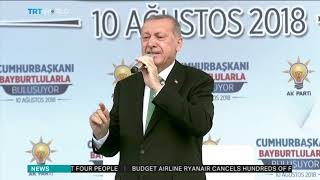
Tourists in Turkey flocked to its high-end shops to snap up bargains on Monday, their purchasing power buoyed by a currency crisis as the country’s lira sank to a record low beyond 7 per dollar. The line outside the Chanel and Louis Vuitton stores was really huge in the Istanbul neighborhoods, with tourists waiting to reap the benefits of a meltdown that saw the currency lose 18 percent on Friday alone. “We’re buying clothes, we’re buying makeup, we’re buying brand names,” said Fatima Ali from Kuwait, visiting the city with her two daughters. “The prices are very cheap.” Like many of her fellow shoppers, Ali brought her suitcases along to fill up. She stood outside a makeup store holding three. The lira has lost more than 40 percent against the dollar this year, amid worries about President Tayyip Erdogan’s influence over the economy, his repeated calls for lower interest rates, and worsening ties with the United States. Erdogan has also urged Turks to extend their hospitality to tourists, who were bringing dollars into the country at a critical time. “You are already very hospitable but keep that up and extend it. Because at a time when some people are taking out dollars, they are bringing it to you,” he told a crowd of supporters at the weekend. Portraying the lira weakness a plot, Erdogan has repeatedly called on Turks to sell their dollars to shore the local currency up. An employee at an upscale clothing store who declined to give his name said the amount of shoppers was unusual even in high season, attributing it to the lira’s fall. One Egyptian shopper estimated he had saved about $1,000 in comparison to buying the same gifts and clothes at home. “We hope that the currency, for Turkey’s sake, becomes better,” said another, Khalid al-Fahad from Kuwait. “And at the same time we hope for the sake of customers here that the lira remains as is.” Reporting by Bulent Usta and Yesim Dikmen #ReutersNews #Reuters
- Israeli Arabs in a rally against Jewish nation-state law
Time to travel beyond the U.S. borders and check it out what happens in the Holy Land, in Israel, because the Arab minority there is getting up against the new nation-state law. Thousands of protesters rallied in Rabin square of Tel Aviv on Saturday against Israel’s new law declaring it the nation-state of the Jewish people, legislation that has angered the country’s Arab minority and drawn criticism abroad. Prime Minister Benjamin Netanyahu has defended the law, which says only Jews have the right of self-determination in the country and downgrades Arabic from an official language, saying it is necessary in order to fend off Palestinian challenges to Jewish self-determination. The protesters, mostly Israeli Arabs, waved Palestinian flags and held up signs that read ‘equality’ in Arabic and Hebrew. “The law legitimizes racism,” said Laila al-Sana, 19, from a Bedouin village in Israel’s southern Negev desert. “It’s very important to show we are here, to resist,” she said. Israel’s Arab population comprises mainly descendants of the Palestinians who remained on their land after the 1948 war at the time of the creation of the modern state of Israel. Hundreds of thousands were forced to leave their homes or fled. Israeli Arabs and their supporters take part in a rally to protest against Jewish nation-state law in Rabin square in Tel Aviv, Israel August 11, 2018. REUTERS/Ammar Awad Many of Israel’s Arab citizens also identify as Palestinian. They make up about a fifth of the state’s 9 million people. Israeli law grants them full equal rights, but many say they face discrimination and are treated as second-class citizens. “When I heard about the law I felt I should defend my hometown, our land, the land of my ancestors,” said 68-year-old Sheikha Dabbah at the rally. Largely declarative, the law was enacted just after the 70th anniversary of the birth of the state of Israel. It stipulates that “Israel is the historic homeland of the Jewish people and they have an exclusive right to national self-determination in it”. It also downgrades Arabic from an official language alongside Hebrew to a “special status.” “I feel ashamed that after 70 years I have to accentuate my nationalism instead of being generous towards all those who live here,” said Gila Zamir, 58, a Jewish Israeli from the Arab-Jewish city Haifa. Netanyahu posted on his Twitter page a video from the demonstration of a few protesters waving the Palestinian flag and chanting: “With spirit, with blood we shall redeem you, Palestine” and wrote: “There is no better evidence of the nation-law’s necessity.” Separate TV footage showed a few Israeli flags being waved. Critics have said the new law is undemocratic because it differentiates between Jewish and non-Jewish citizens. Its defenders say civil equality is guaranteed in existing legislation. Arab leaders in Israel have said the law verges on apartheid. Rights groups and Jewish groups in the Diaspora have spoken against the legislation, as have the EU, Egypt and Israel’s own president. Last Saturday a protest against the law by Israel’s Druze community, which numbers about 120,000 citizens, drew a far larger crowd. The Druze is ethnic Arab members of a religious minority that is an offshoot of Islam incorporating elements of other faiths. Their outrage over the law has had more resonance in Israel, despite their small numbers, because of their reputation as loyal supporters of the state. Unlike the wider Arab population, many Druze serve in Israel’s conscript military and security forces, and some have raised high in the ranks. Druze leaders have voiced a deep sense of betrayal over the law, striking a chord among many Israelis. However, efforts by Netanyahu to appease the Druze community have so far failed. Reporting by Haia Dakwar; #ReutersNews
- I want the Narcissists Victims to Know this...
NO is an aggressive word but very useful to protect you from the Narcissist who can destroy not only your happiness but will definitely destroy your life. A huge and decisive NO will keep you far away from manipulative people who can change you into a Devil! Here is a testimony of a Narcissist victim and her advice for a healthy life with yourself. I just want to start this letter by saying I get it—I’ve been there too. In fact, for a number of years, I traded one narcissist for another—each one more charming and less obviously a narcissist than the last. So, when I say that I can appreciate the damage and destruction they cause to someone, I really mean it. I also understand the intense pain, sorrow, anger, and emptiness that is felt when we finally extricate ourselves from the claws of the narcissist. I want other victims to know this: regardless of the depths of pain that we initially felt, there is a light at the end of the tunnel. Ultimately, each time we overcome the influence of a narcissist we’re left a stronger, more resilient version of ourselves. Hold onto that hope. Please know that is what the future holds. Also know that people who fit into the “empathy” personality category attract a higher number of narcissists into their lives, simply because empathy are more likely to be people-pleasers, and less prone to having strong boundaries. That’s what narcissists (and sociopaths) want—to find someone they can easily control and manipulate. The purpose of this letter, however, isn’t to rehash what we already know to be true about narcissists—that they are left a trail of destruction for any person they touch. My purpose, rather, is to share my journey and what I have found to be the three most important steps to healing the invisible scars that were left behind, and to move forward with life. The first step is realizing that there is no “fixing” or “saving” a narcissist. As much as we’d like to think that we can simply love these people back together, we cannot. It’s like thinking that we can love a crocodile or shark into not attacking its prey. Nature designed crocodiles, sharks, and even narcissists the same way—to attack their prey. No amount of love will change that programming. Move away, get away, cut ties. We need to move as far away from the narcissist as possible, as quickly as possible. Change cities, change states. Hell, I left the country to get away from mine! Make this move with an awareness that they will come calling. Initially, the narcissist will be remorseful (an emotion they’re actually not capable of feeling) to trigger our guilt and that they’ve always used in the past to get us to stay. Then, when they’ve realized they no longer have control, they’ll get angry. This anger will lead them to say all kinds of nasty things to others about the victim. When the narcissist loses control of us, they will attempt to control how others see us. Don’t go back. Going back won’t solve anything; it’ll only make things worse. Regardless of what they say, continue to move away from them. Instead, focus on self-love, focus on those deep seeded passions within. Those were the things that saved me. Self-forgiveness is arguably the hardest step in the journey; however, this is the step that ultimately leads to freedom. Oftentimes, we seek to forgive the narcissist, thinking that will allow us to escape the ties to the past. The problem with that logic is this: by forgiving the narcissist we excuse their behaviour, we make it okay. Forgiveness, in the absence of a genuine apology, means to let someone off the hook for their behaviour. Narcissists will never genuinely apologize. Therefore it’s not them who need our forgiveness, it’s us! We need to forgive ourselves for being naïve enough to think we could change them. We need to forgive ourselves for staying, for putting up with their behaviour, for being blind to their manipulation and control. Mostly, we need to forgive ourselves for not realizing and knowing implicitly that we deserve so much more, that we are worthy. Having healed my wounds I can say this isn’t an easy journey. However, I’ve never done something in my life that was more important than taking these steps. And while it might seem counterintuitive to say, I can now look back at this journey with an odd sense of gratitude, and know that without those narcissists I may never have found the greatest gift of all… Myself. With love, a Survivor #elephantjournal